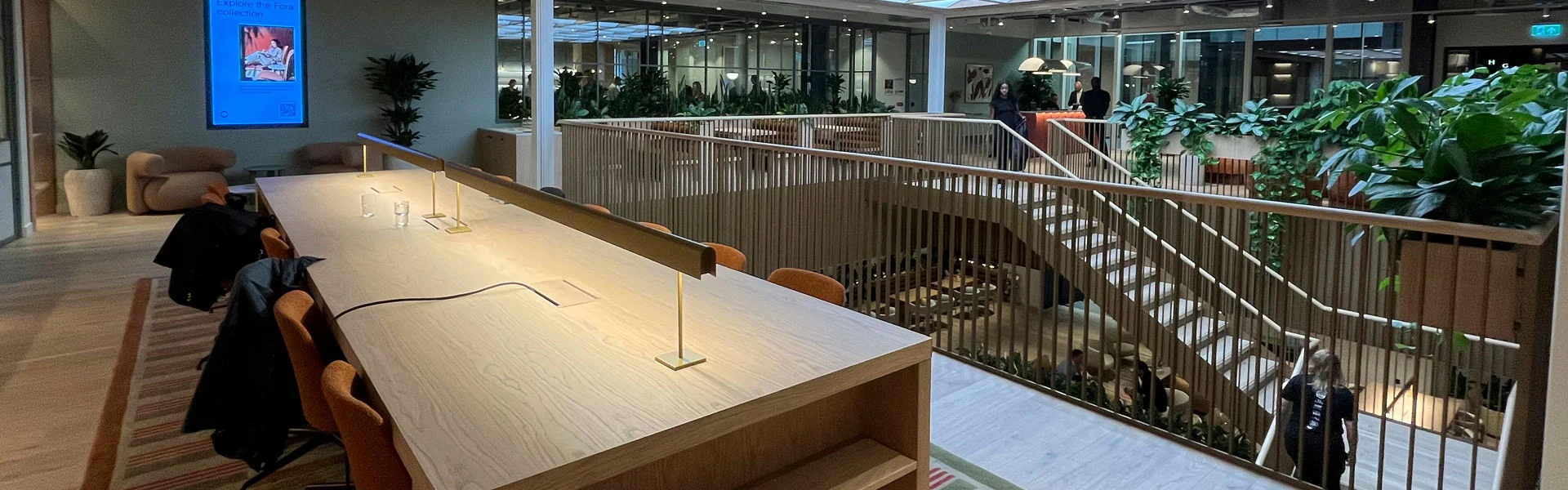

Downsizing to Upgrade: How Reducing Fixed Square Footage Can Fund Employee Flexibility
In recent years, a significant shift in workplace strategy has emerged: companies are realising that they don’t necessarily need more office space; they need smarter office space. The rise of hybrid working has revealed a structural inefficiency in the traditional leasing model; firms continue to pay for peak headcount, even when their offices are rarely at full capacity.
This article is a collaboration with Christoph Fahle, Founder and CEO of One Coworking, who has dedicated over 15 years to shaping the European coworking ecosystem. While OfficeBroker.io assists companies in finding suitable offices across London, Christoph and his team work to connect businesses with high-quality, flexible workspace networks in cities such as Berlin, Madrid, and Amsterdam.
Together, we examine a model that many forward-thinking companies are beginning to adopt: reducing fixed office space while increasing access to flexible workspaces. The outcome is often counterintuitive: smaller headquarters can lead to a more effective overall workplace strategy.
1. The London Real Estate Paradox
In London, office strategy often collapses under its own assumptions. Companies lease for peak headcount, yet peak attendance rarely materialises. Hybrid work is no longer experimental. Multiple post-pandemic surveys from consultancies such as PwC, McKinsey, and JLL consistently show average office utilisation in large cities hovering well below pre-2020 levels, often around half of contracted capacity.
The result is a structural mismatch. Firms pay prime rents to house people who are not there. To manage costs, they compromise: larger offices in fringe locations, older buildings, or layouts that dilute brand and employee experience. This is the fixed-cost trap. Rent, business rates, and service charges do not flex when desks sit empty.
A different model has emerged. Instead of maximising square footage, leading firms optimise presence. They anchor culture and leadership in a smaller, premium central hub, then give employees access to professional workspaces closer to home. This “Hub-and-Spoke” model reframes real estate as a variable operating expense rather than a sunk commitment. The outcome is counterintuitive but measurable: a smaller headquarters, higher perceived quality, and greater employee autonomy.
2. The Financial Model: Fixed vs Variable OpEx
The Traditional Lease
A 50-person office in Central London carries layered costs beyond headline rent. Market reports from Savills and CBRE show that prime Zone 1 offices command some of the highest rents in Europe, and that rent is only the starting point. Business rates, service charges, utilities, fit-out amortisation, and ongoing maintenance typically add a substantial premium to the base figure.
Critically, these costs are fixed. Whether 20 or 50 people show up, the monthly outflow remains unchanged. For finance leaders, this creates an efficiency problem: capital is locked into space rather than deployed toward growth, talent, or technology.
The Hub-and-Spoke Alternative
The Hub-and-Spoke model separates representation from capacity.
The Hub
A 20-person private office in a prime district such as Shoreditch or Mayfair serves as the company’s public face. Leadership, client meetings, onboarding, and key moments of collaboration happen here. Premium buildings provide modern infrastructure, sustainability credentials, and services that would be cost-prohibitive at larger scales.
The Spoke
The remaining employees receive access to a network of professional workspaces on demand. These passes are consumed only when used, converting unused square footage into a variable cost aligned with actual attendance.
The Math
When companies reduce their permanent footprint by roughly 40 per cent, the savings typically exceed the cost of providing flexible access for the wider team. Industry benchmarks from flexible workspace operators show that distributed access costs a fraction of a full-time desk in Zone 1, while eliminating long-term lease liabilities.
For CFOs, the result is a dual gain: total monthly occupancy spend drops by a mid-teens percentage, while employees experience better locations, better amenities, and more autonomy. Quality rises as quantity falls.
You can also calculate your Instant Workspace ROI.
3. Geography Strategy: Solving the Zone 4-6 Commute
London’s talent does not live in Zone 1. Transport for London data shows that large segments of the workforce commute from Zones 4 to 6 or beyond. Daily travel from areas such as Croydon, Ealing, or Enfield routinely exceeds an hour each way.
Commute fatigue is not a soft issue. Long travel times correlate with lower job satisfaction, higher stress, and reduced discretionary effort. Hybrid work mitigated this problem, but many firms replaced office time with home isolation rather than professional alternatives.
The Hub-and-Spoke model introduces a third option. When employees can work two days per week from a nearby professional hub instead of travelling into central London, the time savings compound. Four or more hours per week return to the employee without sacrificing focus or ergonomics.
This matters for retention. Surveys by CIPD and Gallup repeatedly link flexibility with lower attrition risk, especially among experienced knowledge workers. Importantly, local work hubs outperform home offices for deep work. They provide separation, infrastructure, and social cues without the cognitive tax of a long commute.
4. Tech and Innovation: Managing a “Liquid” Portfolio
Flexible real estate only works at scale when it is operationally invisible. Modern platforms enable companies to manage distributed access through a single interface, including real-time usage tracking, cost controls, and policy enforcement.
This changes the broker’s role. The modern broker is no longer a finder of square footage but an architect of ecosystems. Firms like officebroker.io operate at this intersection, combining traditional market expertise with flexible inventory and data-driven oversight.
For finance and operations teams, the benefit is agility. Headcount changes no longer require renegotiation, subletting, or legal friction. Space scales with demand. When markets tighten or teams expand, capacity adjusts without a balance-sheet shock.
Workspace networks such as One Coworking aggregate premium offices and local hubs into a single access layer, allowing finance teams to treat distributed space as a controllable operating expense rather than a fixed asset.
5. Implementation: A Three-Step Transition for CFOs
• Step 1: Audit Utilisation
Badge data, booking logs, and attendance surveys quickly reveal the truth. Most firms discover predictable patterns: peaks midweek, troughs on Mondays and Fridays, and departments with divergent needs.
• Step 2: Define The Anchor
Select a headquarters that reflects the brand, not the headcount. A premium hub signals stability and ambition while minimising the number of unused desks. Specialist brokers help align building choice with cultural and client-facing goals.
• Step 3: Deploy The Pass
Partner with a workspace network to provide distributed access. Clear policies define who uses flexible space, when, and within what budget. Finance teams retain control; employees gain choice.
6. Quality Over Quantity
The decade-long lease on a massive floorplate belongs to a different era. In 2026, resilience comes from flexibility, not excess capacity. The best office is not the largest one. It is the one that appears where work actually happens.
For companies willing to downsize intelligently, the reward is an upgrade: lower fixed costs, stronger employer branding, and a workforce that works better because it works smarter.
This article was created in collaboration with One Coworking, a platform that helps companies discover and access flexible workspaces across Europe. As organisations reassess their office space needs, partner platforms like One Coworking simplify the process of matching teams with suitable workspace solutions, whether they involve coworking hubs, flexible offices, or hybrid workspace memberships.
By integrating flexible workspace expertise with practical office search experience, collaborations like this enable businesses to make informed decisions about their office usage in a hybrid working environment.