

How To Rent Your First Office in London on a Budget
Congratulations on reaching this stage in your journey! You are considering renting your first office space in London without straining your budget. Beyond just the rent, it’s important to account for other associated costs when occupying an office in the City. This guide will help you find and rent cheap office space in London.
Finding the perfect office space in London can be time-consuming and stressful. Do you pay an agent to negotiate a lease for an office or use a broker to rent an office? To draw comparisons, you need to understand the costs of each to ensure an apples-for-apples comparison. Luckily, with our quick guide to finding and renting an office space in London, you’ll be able to locate the ideal workspace for your business in no time.
Finding Cost-Effective Workspaces in London.
Location, Location, Location
When looking for available office space in London, it’s important to have an idea of the areas you want to search in and the rental terms that work best for your business. Look into what type of transportation links are nearby; commuting times can be shortened if you rent a workspace near public transport hubs, such as stations and bus stops.
Setting Your Price Range & Budget
You should also have an idea of how much you can afford to pay in rent each month and what length of lease you are comfortable with. When researching potential workspaces, ensure you gather all this information before making any decisions. When renting office space, it’s essential to set a price range and budget for rental costs. This should be based on the office size required and the type of lease you’re seeking. Short-term leases tend to cost more than long-term leases but offer greater flexibility.
Future Proofing Your Office Design
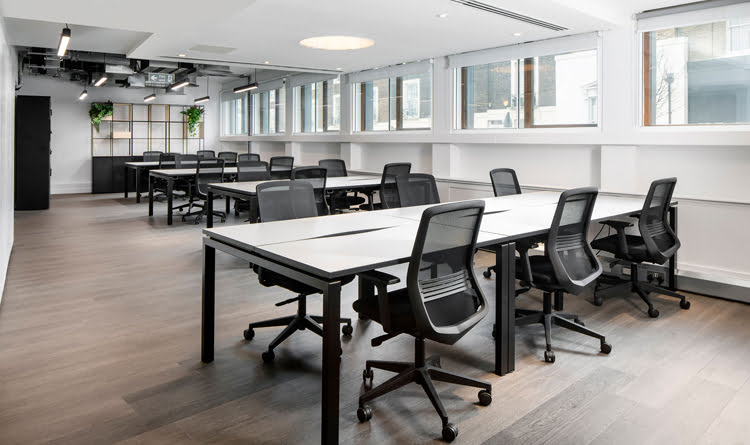
As you start looking for cheap office space in London, it’s important to think about the type of workspace that would best suit your business. This could include an open-plan desk area,, private, lockable offices,, a meeting room, or Breakout areas. Consider how much workspace you need and whether there will be any specific requirements, such as disabled access or ample storage. You should also consider the amenities in the surrounding area—such as cafés and restaurants—that can support staff morale and help attract talent.
Thinking ahead, what are the growth plans for the business? If your business is seasonal or staffing levels fluctuate, you don’t want to pay for space you don’t use. Serviced office space is great for this reason:
The licence agreement for a serviced office is flexible and can range from 3 months to 3 years, so you are not tied in the long term.
If your team outgrows the space, you can generally take on additional space within the business centre. All you need to do is speak to the centre manager and discuss your plans. The same scenario is slightly different for leasehold office space, as the contract term is typically longer (3 to 10 years, with a break clause halfway through is common), which makes it harder to design the space to accommodate fluctuating staffing levels.
Are Business Rates Included?
Working out business rates can be tricky, as they vary by borough. Business rates are calculated by multiplying your rental cost (rateable value) by a multiplier. Luckily, the UK government website has a handy business rate calculator that you can use. Business rates are included in the monthly cost of serviced offices, whereas you will need to factor these in (and be responsible for organising and payment) if you want to lease an office.
Factoring in the Cost of Utilities
As mentioned above, all utilities are generally included in the monthly cost of service offices. If you opt to lease an office, you’ll be responsible for setting up and paying for electricity, gas, water, ADSL/Fibre internet including failover) connections and phone lines. To avoid hidden costs, consider an all-inclusive office space and ensure it remains cost-effective.
Rent vs Buy Office Furniture
If you have ever needed to buy new office furniture, you know how expensive it can be (and how difficult it can be to shift once it is no longer needed). This is why furniture is treated as a commodity and has very little resale value at the end of its term. Many find themselves either giving away furniture for free or paying for storage to house desks and chairs that will likely never be used again. The good news is that serviced offices are typically fully furnished, so you only need to bring your IT, and you are good to go. Chairs, desk, cabinets, coat stands. Most are available. Ask the building manager if you want to remove or add furniture, and they will generally accommodate this for you at no charge.
The Unnamed Extras
Access to meeting rooms and Breakout spaces is included and can be included in your monthly payment. Teas and coffees, free breakfast, beer and pizza and networking events need to be factored in. Whereas in a leasehold office, you need to build in additional sq. ft regardless of whether it’s used 24/7 or simply a transition space, such as a toilet. Maintenance and upkeep are either your responsibility for (leasehold) or the serviceprovider’s for (managed or serviced office space).
View Workspaces Before Negotiation
Once you have a clear idea of the location, cost, size, and amenities you want for the office, it’s time to start discussing terms with potential office owners. Make sure to negotiate rental terms and secure rental paperwork as soon as possible so nothing delays your transition into a new workspace.
Where Can I Find Cheap Office Space?
If you need help navigating the London office market, our team is here to help you. With expert on-hand guidance, we’ll walk you through the available options and work with you to secure the best space for your budget.
For more information, call 020 3838 2008, and we’ll help you find your perfect space on a budget that suits you.