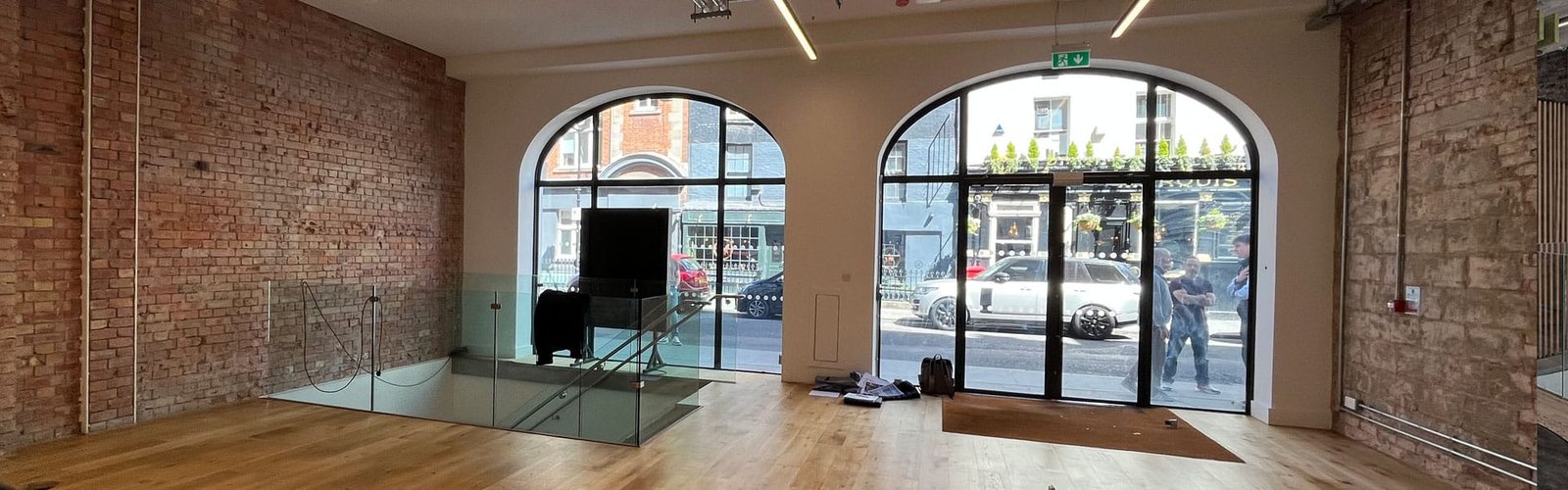
Creating a Purpose-Built Proprietary Trading HQ
How We Helped Deliver a Purpose-Built Trading Headquarters for Axia Futures
Every office tells a story. Some are designed around desks. Others are designed around the businesses that rely on them.
Delivering Axia Futures’ new headquarters was never about finding another office. It was about creating an environment that could support one of London’s most respected proprietary trading firms.
For a proprietary trading business, even a few seconds of downtime can have operational consequences. Delivering a headquarters capable of supporting several floors of professional trading is something entirely different. Trading headquarters place demands on a building that extend far beyond those of a typical office. Low-latency connectivity, resilient power infrastructure, high-capacity cooling and uninterrupted operational performance all become business-critical. These requirements fundamentally change the office search, shifting the focus from finding attractive workspace to identifying a building capable of supporting a highly specialised operation.
When Axia Futures instructed OfficeBroker.io to assist with the delivery of its new headquarters, the brief extended well beyond identifying suitable office space. Over the following months, we evaluated more than fifteen buildings, negotiated a bespoke lease and remained closely involved. This is the story of how we delivered what would become Axia’s flagship London headquarters.
Understanding the Brief
When Axia Futures approached OfficeBroker.io for a second time, this wasn’t simply another office search. It marked the next chapter in a relationship built on trust, collaboration and a shared commitment to delivering the right long-term outcome.
Having supported the business during its previous relocation, we already understood far more than its property requirements. We understood how the business operated, how its traders worked together, the importance of resilient infrastructure and, perhaps most importantly, the standards the team expected from those representing them. That understanding came from asking the right questions, and listening carefully to the answers.
Our involvement in the previous project also continued long after the lease was completed. We remained available to help resolve operational issues, liaise with building management and ensure the office functioned as intended once the team had settled into their new workspace. Rather than viewing lease completion as the end of the process, we saw it as the beginning of helping the client make their new office a success.
That continuity meant we didn’t need to spend time learning how the business worked. We could immediately focus on designing the right solution for its next stage of growth.
A Vision Beyond Relocation
At the time, Axia Futures was operating successfully across several floors within a converted townhouse. Although the arrangement met the business’s operational needs, it naturally created separation between experienced traders, support staff and those progressing through Axia’s highly respected training programme. Opportunities for collaboration, mentoring and day-to-day knowledge sharing were often limited simply because teams were physically separated.
The objective wasn’t simply to move into larger premises. It was to create a headquarters where experienced traders and new recruits could work alongside one another, strengthening collaboration while enhancing the culture that has become one of Axia’s defining characteristics. The new headquarters also needed to provide long-term financial certainty while supporting future growth. Rather than relocating every few years, Axia wanted to establish a permanent London headquarters that reflected the business’s professionalism. The office needed to provide the flexibility to evolve as the company expanded.
Finding the right office would therefore represent only the first stage of the project. Designing an environment capable of supporting the business for many years to come would prove equally important.
Defining the Brief
Unlike a conventional office search, this project wasn’t driven primarily by location or desk numbers. Every trading workstation needed to support multiple high-performance computers and up to 10 monitors. This placed significant demands on the building’s electrical infrastructure, cooling systems, and communications network, exceeding normal expectations. Reliability wasn’t simply desirable – it was essential.
Axia would require resilient power distribution, business-grade connectivity and infrastructure capable of supporting uninterrupted trading throughout the working day. Whilst aesthetics and location remained important, they could never come at the expense of operational performance.
Alongside the main trading floor, the office also needed executive offices, breakout areas, collaboration areas and a dedicated podcast studio to support Axia’s growing educational and media presence. The newly created podcast studio introduced its own technical requirements, requiring dedicated power and independent data connectivity. Continuous fresh-air ventilation and carefully considered acoustic separation needed to be considered without extensive alterations to the building’s existing HVAC infrastructure.
The real question was no longer if a building looked impressive. It became a question of whether it could genuinely support a modern proprietary trading operation. To answer that, every property was assessed against the same set of questions:
- Could the electrical infrastructure comfortably support dozens of trading desks?
- Would the cooling systems perform under continuous load?
- Could specialist data infrastructure be installed efficiently?
- Would the building accommodate the bespoke fit-out the business required?
- Could the office evolve alongside the business without significant compromise?
Only by answering those questions could we determine whether a building was genuinely capable of becoming Axia Futures’ next headquarters.
Searching the Market
With the brief clearly defined, the next challenge was understanding the wider market. At OfficeBroker.io, we believe the quality of an office search is determined long before the first viewing. Our role isn’t simply to present a shortlist of available offices. It’s about understanding the market as a whole, challenging assumptions, and identifying opportunities that others may overlook.
As part of that process, we even revisited legacy listings that Axia had independently identified through online property portals, verifying availability and ensuring that potentially suitable opportunities weren’t dismissed simply because they had been marketed for some time. Every possible avenue was explored before recommendations were made.
When beginning a new search, no business can afford to limit its search to the portfolio of a single landlord or the instructions held by one commercial agency. The ideal building may be marketed by anyone, and the right solution is rarely found by looking in only one place. Instead, we conducted an extensive search across the City of London and Fitzrovia, reviewing opportunities ranging from approximately 2,500 sq ft to more than 4,200 sq ft. Our objective wasn’t simply to identify available office space. It was to find a building that could serve as Axia’s long-term headquarters.
An Independent View of the Market Beyond the Standard Listings
One of the greatest advantages of working with an independent office broker is the freedom to explore every opportunity available. Working alongside leading commercial property advisers, including Knight Frank, CBRE, Colliers, and RX London, we also engaged directly with major landlords, including British Land, The Langham Estate, and several independent property owners, to ensure no suitable opportunity was overlooked.
Every viewing was personally arranged, coordinated and accompanied by OfficeBroker.io, allowing Axia to compare buildings on their individual merits rather than on who happened to be marketing them. Every viewing, every conversation and every recommendation was driven by one simple question: would this building genuinely support the way the business operates?
Due Diligence in Practice
Over the course of the search, we coordinated viewings across more than fifteen buildings. To some, that may sound excessive. For us, it represented due diligence. Every viewing refined our understanding of the brief. Some buildings immediately impressed with their natural light, communal facilities and overall presentation but lacked the ingredients to create a specialised trading environment.
Others provided generous floorplates, yet their layouts would have required significant compromises to the proposed trading floor. There’s no value in paying for space that the business can’t utilise effectively.
Questions around electrical capacity, cooling performance, communications infrastructure, landlord flexibility and future scalability quickly separated genuinely suitable buildings from those that looked impressive on paper. This is where specialist office searches differ most significantly from conventional relocations. A beautifully designed office can still be entirely unsuitable for the business that intends to occupy it.
Refining the Brief
One of the most valuable aspects of any comprehensive office search is recognising that the brief rarely remains static. The process itself teaches everyone involved.
Early discussions centred on creating a predominantly open-plan trading floor to bring the entire team together. However, as we explored more buildings and challenged different layouts, it became clear that a more carefully zoned workplace would deliver better long-term results. The objective wasn’t simply to maximise the number of desks. It was to create an environment that reflected how the business actually operated.
Dedicated collaboration areas would encourage discussion without disrupting concentration. Private offices would provide space for confidential conversations. Breakout areas would allow the team to step away from the trading floor without becoming disconnected from it. The podcast studio continued to evolve, becoming an increasingly important part of the overall workplace strategy while remaining acoustically separated from the core trading environment. Every viewing helped refine these ideas.
Instead of searching for a building that fit an original concept, the search became an iterative process in which each building shaped a better understanding of what the headquarters needed to become. By the end of the viewing schedule, Axia had developed a far clearer understanding not only of which buildings worked but also of why many others did not. That knowledge proved just as valuable as the shortlist itself. By the conclusion of the search, one building had consistently remained at the top: 15 Rathbone Street.
Choosing the Right Partners
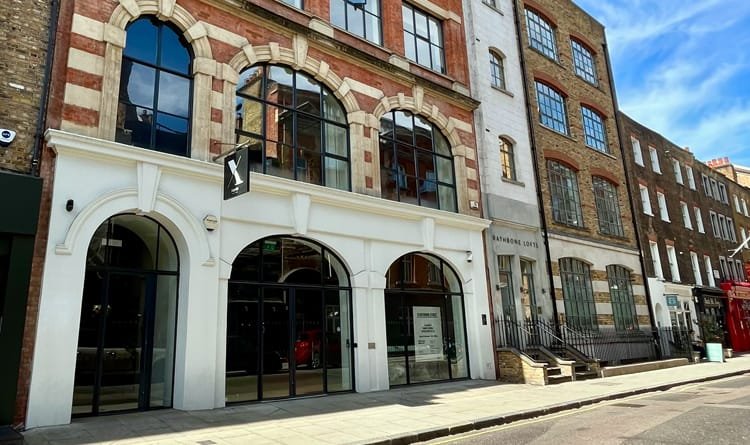
By the conclusion of the search, one building had consistently remained at the top of the shortlist. 15 Rathbone Street had become the benchmark against which every other property was measured.
The opportunity had originally been introduced to OfficeBroker.io by Workplace Plus, who were working alongside Knight Frank on behalf of Fabrix to bring the building to the market on a managed basis. We included it within the wider search and, as with every other opportunity, assessed it against Axia’s operational, technical and commercial requirements.
That distinction was important. 15 Rathbone Street wasn’t simply selected because it was an opportunity already known to Workplace Plus. It had to stand up against more than fifteen other buildings we had sourced, reviewed and arranged for Axia to view across the London market. Ultimately, it did.
Unlike many offices across Central London, 15 Rathbone Street offered something increasingly difficult to find: genuine flexibility. Rather than forcing Axia to adapt to an existing fit-out, the building provided the opportunity to design a workplace around how the business actually operated. For a proprietary trading firm with highly specialised technical requirements, that distinction was fundamental.
The previous office had served the business well. However, like many serviced environments, it inevitably required compromise. This project offered something different.
Power distribution could be planned around high-density trading desks rather than adapted afterwards. Communications infrastructure could be designed specifically for the business rather than retrofitted into someone else’s layout. Cooling systems, workstation configuration, executive offices, collaboration spaces, and specialist facilities could all be considered part of a single integrated workplace strategy.
Instead of asking, “How can we make this office work?”, the question became: “How can we create the best possible environment for the business?” Just as importantly, the building provided room for future evolution.
The objective was never to deliver an office that worked only on the day of occupation. It was to create a headquarters capable of supporting the next stage of Axia’s growth without forcing the business back into the market a few years later.
More Than Four Walls
One of the most important decisions ultimately had very little to do with the office itself. Commercial property is often judged by its location, specification and rental terms. In reality, the long-term experience of occupying a building is shaped just as much by the people responsible for owning, operating and maintaining it.
For a business investing heavily in a specialist trading headquarters, those relationships become every bit as important as the physical workspace. Technical questions arise. Businesses evolve. Operational requirements change.
Having experienced people who understand the building and are committed to supporting its occupiers can make an enormous difference throughout the lifetime of a lease. Throughout the search, we encouraged Axia to look beyond the physical office and consider the organisations they would ultimately work alongside.
The Importance of Operations
Fabrix are an award-winning real estate investment and development company working across the workplace and sustainable living sectors, with a strong record in repositioning and improving commercial buildings across London. They operate from 15 Rathbone Street. Their presence in the building gave Axia additional confidence that future issues could be addressed by a team with a genuine understanding of the building and the businesses operating within it. It also demonstrated Fabrix’s long-term commitment to the building and its occupiers.
For Axia, understanding the people behind the building and those responsible for its day-to-day operation became an important part of the decision-making process. Workplace Plus would provide the operational management of Axia’s office space.
Building operators often receive little attention during an office search, yet they are the people businesses interact with regularly once a lease is completed. From coordinating building services and facilities management to responding to maintenance requests and supporting future changes within the office, their role can have a significant impact on the occupier experience.
For many businesses, these services need to function efficiently. For a professional trading firm, they become considerably more important. Cooling systems must perform consistently, communications infrastructure must remain dependable, and maintenance issues must be addressed promptly. Throughout the discussions, Workplace Plus and its partners demonstrated a clear understanding of these operational priorities and a willingness to collaborate with Axia, OfficeBroker.io, Fabrix, and the wider consultant team.
Choosing the Right People
Looking back, one of the most important decisions wasn’t selecting a building. It was selecting the people who would stand behind it. The combination of an engaged landlord, an experienced building operator and a collaborative professional team provided reassurance that extended well beyond the office itself.
At OfficeBroker.io, this reinforces something we regularly discuss with clients. An office isn’t simply a workplace. It’s an ongoing relationship. The quality of that relationship often has a greater influence on a tenant’s long-term experience than the reception finishes, the furniture or even the building’s location.
Ultimately, Axia wasn’t simply choosing where it would work. It was choosing the people it wanted to work alongside for the next five years. That confidence became one of the defining reasons why 15 Rathbone Street emerged as the clear choice for the business.
Structuring the Right Deal for Axia Futures
With the preferred building identified and the wider project team beginning to take shape, attention turned to agreeing a commercial structure that would support both the business’s immediate requirements and its long-term ambitions.
The objective was never to negotiate the lowest possible rent. The strongest agreements are those in which both parties are confident that their respective long-term objectives have been understood. Our focus was therefore on creating a lease structure that gave Axia confidence to invest in its new headquarters, while also recognising the commercial priorities of all parties involved.
Working closely alongside Workplace Plus and Knight Frank, we remained actively involved throughout the negotiations, helping bridge discussions between Axia and Fabrix and ensuring the final agreement reflected the business’s operational requirements alongside the landlord’s objectives.
The result was more than a standard lease negotiation. It was a commercial framework designed to provide certainty, appropriate flexibility and long-term value.
Building Flexibility into the Lease
Growing companies often face a difficult decision. Commit to a long lease and risk outgrowing the office. Or retain maximum flexibility through a shorter commitment, potentially limiting the confidence to invest in creating a bespoke workplace. Our objective was to remove that compromise.
Following detailed discussions, a lease structure was agreed that provided Axia with an appropriate level of commitment while retaining flexibility at an agreed point in the term. This gave the business the confidence to create a headquarters designed around its requirements today, while preserving the ability to respond should its future needs change.
Rather than focusing solely on the headline rental figure, the negotiations considered the lease as a whole and how its various provisions could support the business throughout the occupation.
Creating Long-Term Value
Commercial negotiations are often judged against a single number. In reality, the long-term value of an agreement is typically determined by a much broader range of commercial considerations.
Throughout the negotiations, we explored opportunities to strengthen Axia’s overall position while recognising the landlord’s own commercial objectives. The final agreement incorporated several commercial terms designed to support Axia’s significant investment in the delivery of its specialist trading headquarters.
Importantly, the discussions considered the overall balance of the transaction rather than treating each lease term in isolation. By taking a holistic approach to the commercial structure, it was possible to create additional value for Axia while providing appropriate reassurance to the landlord.
The strongest agreements are rarely those where one party wins more than the other. They are agreements in which both landlord and tenant leave the table confident that their long-term objectives have been understood. That collaborative approach laid the foundations for what would become a highly successful project.
With the lease agreed, the focus shifted once again. The property search was complete. Now the real work of transforming an empty office into Axia Futures’ new headquarters could begin.
Delivering the Infrastructure
With the lease complete and the keys to 15 Rathbone Street secured, the project entered its most technically demanding phase. Finding the right building had always been only part of the brief. The next challenge was transforming an empty office into a headquarters capable of supporting one of London’s most respected proprietary trading firms.
Unlike many office relocations, this wasn’t simply a case of installing furniture and connecting computers. Every decision made during the fit-out would directly influence the reliability, resilience and day-to-day performance of the business for years to come.
Many of the most important decisions would never be visible once the project was complete. Yet they would become some of the most important.
Building on Axia Futures Foundations
Before work began, the existing telecommunications infrastructure was carefully reviewed to understand where existing cable routes could be reused. Wherever possible, legacy routes were retained, reducing the need for additional wayleave applications, shortening installation programmes and avoiding unnecessary costs without compromising performance. Specialist satellite equipment also required careful consideration.
Independent quotations were obtained for its removal, relocation and recommissioning, ensuring Axia retained the resilient communications infrastructure essential to its trading operation. With the core infrastructure agreed, work could begin on building a communications network designed specifically around the business.
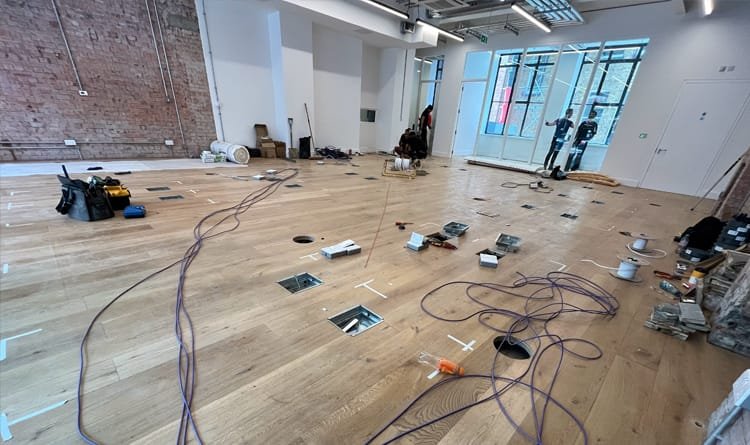
More than 4 kilometres of Cat6 data cabling were installed throughout the ground and lower ground floors, providing dedicated connectivity for approximately 45 trading workstations, executive offices, meeting rooms, collaboration areas and specialist support spaces. Every workstation was designed with low-latency and redundancy to support the way Axia traded.
Each position could support multiple high-performance computers, up to 10 monitors, and an uninterruptible power supply (UPS), providing additional resilience in the event of a power interruption. Much of this infrastructure now sits hidden behind walls, ceilings and floor boxes. Visitors will never see it. Yet it forms the backbone of the entire workplace.
Engineering for Performance
Communications infrastructure represented only part of the challenge. Cooling and electrical capacity became equally critical considerations. High-performance trading environments generate significantly more heat than a conventional office, placing sustained demands on mechanical and electrical systems throughout the working day.
Before occupation, the existing HVAC installation was fully serviced, recalibrated and tested to verify that it could comfortably support the anticipated cooling requirements of the trading floor. Workplace Plus also provided Axia with a full operational handover, ensuring the team could confidently control individual aspects of the system from the first day of occupation.
The podcast studio presented a different engineering challenge. Rather than undertaking major alterations to the existing HVAC installation, a dedicated fresh-air solution was designed to provide continuous ventilation. This significantly reduced sound transmission into the adjacent trading environment.
Although relatively modest in scale, this solution greatly enhanced the functionality of the completed headquarters and demonstrated how thoughtful design decisions can deliver significant operational benefits.
The Details That Make the Difference
One of the most valuable aspects of specialist occupier representation is identifying challenges that might otherwise remain hidden until after occupation. Electrical capacity provided one such example.
Working alongside specialist contractors and UK Power Networks, the available electrical supply was independently assessed to verify that it could comfortably support the proposed trading operation.
During this review, the existing electrical configuration was examined in detail to ensure that the available capacity was being used as efficiently as possible. The review identified an opportunity to separate certain ancillary building services from the supply serving Axia’s demise, releasing additional capacity for the trading operation. On paper, this might have appeared insignificant. In practice, it introduced unnecessary electrical demand onto a trading floor where resilience was paramount.
Independent quotations were therefore obtained to relocate these circuits onto the landlord’s electrical distribution system, thereby releasing valuable capacity for Axia. This further improved resilience in the event of a power interruption or simultaneous system restart. It’s exactly the sort of detail that most occupiers would never identify during a conventional office search. Yet these are often the decisions that determine how successfully a specialist business operates long after move-in.
Delivering More Than a Fit-Out
Throughout the delivery phase, OfficeBroker.io remained closely involved alongside Axia, Workplace Plus, Fabrix, consultants and specialist contractors.
Our role wasn’t to replace the project team’s expertise. It was to ensure every decision continued to reflect the operational requirements established at the very beginning of the search. Independent quotations were obtained where appropriate to verify value for money. Technical proposals were reviewed and challenged where necessary. Questions were followed through until answers had been obtained.
Communication remained consistent throughout the project, ensuring the client always understood the project’s progress, outstanding actions, and the reasoning behind each recommendation. Most commercial property advisers complete their involvement once contracts have been exchanged.
For us, lease completion marked the beginning of a different responsibility. Seeing the project through to successful occupation. By the time the team moved into their new headquarters, the office wasn’t simply ready for occupation. It had been purpose-built around the way Axia Futures worked.
The Outcome
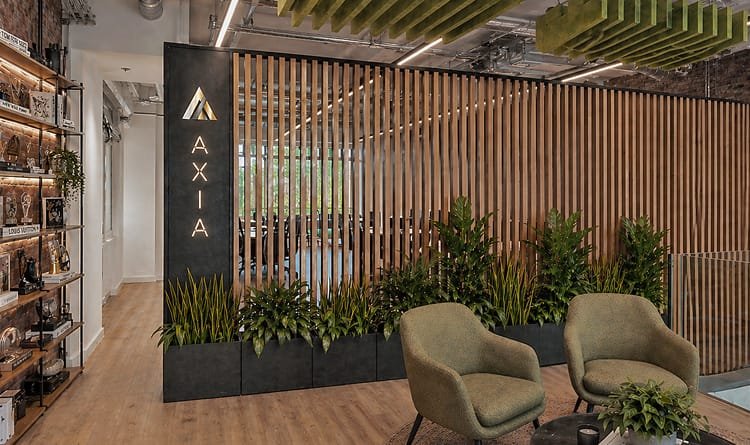
The completed workspace brings together approximately 45 trading positions across 3,200 sq ft of carefully planned office space, supported by resilient communications infrastructure, dedicated power distribution, and optimised cooling systems. More importantly, the project achieved the original objective that had shaped every decision from the very beginning.
By bringing experienced traders, support staff and those progressing through Axia’s training programme together under one roof, the new headquarters has created an environment where collaboration happens naturally. Knowledge can now be shared more easily and freely, and the next generation of traders can learn alongside some of the industry’s most experienced professionals. The office is no longer simply a place to work. It has become Axia Futures’ flagship headquarters.
A Big Thank You
Looking back, this project perfectly reflects what we believe commercial property advice should be. Finding the right building was only the beginning. Delivering a headquarters capable of supporting a specialist trading operation required commercial negotiation, technical understanding, project coordination, attention to detail and, above all, collaboration.
No single organisation delivered this project alone. It succeeded because experienced professionals from across the industry worked towards the same objective. Oskar at Fabrix, Sam and Rebekah from Workplace Plus, Josh at Knight Frank, individual consultants, contractors, specialist engineers and the wider project team each played a vital role in bringing the vision to life. OfficeBroker.io’s role was to remain alongside the client throughout that journey.
OfficeBroker.io helped shape the brief, challenge assumptions, coordinate the market search, support negotiations and continue to act as a trusted adviser long after the lease had been completed.
Projects like this remind us that the best commercial property advice isn’t measured by how quickly a transaction completes. It’s measured by clients’ confidence in the outcome years after they’ve moved in. Want to thank Mario, Steve, Alex and everyone at Axia Futures for once again placing your trust in OfficeBroker.io. It has been a privilege to support another important chapter in your journey, and we wish the entire team every success in your new headquarters.
Planning Your Next Office Move?
Every business is different. Some require a straightforward office search. Others demand a more considered approach that balances commercial objectives, technical requirements and long-term operational needs.
If you’re planning your next office move and would like independent advice from someone who’ll stay with you from the first viewing through to occupation. That’s us; we’d be delighted to hear about your project. Get in touch with our team here.