Office Space as a Service (SPaaS): A US Firm’s UK Expansion
A New York financial services firm asked us to help launch its first UK office. London represented a strategic capital allocation in support of long-term growth. They had an initial team in place with more planned, so the workspace had to support growth from day one without holding them back.
The challenge we faced was not about availability; it was about finding infrastructure that would support our growth over the next twelve months. A poor decision could lead to operational delays, limit our hiring capabilities, increase costs, or mean an early relocation during a critical growth period.
We approached the mandate with the perspective of Office Space as a Service (SPaaS), treating flexible workspaces as a structured, scalable operational platform rather than simply a short-term real estate choice.
Office Space as a Service (SPaaS) for a US Financial Firm’s UK Launch
The objective was to find a space in a well-connected Zone 1 location for an initial team of four people. The chosen option needed to allow for easy expansion within the same building or property portfolio to accommodate the team’s growth.
Key Criteria Included:
* Discretion within a multi-tenant environment
* Institutional-grade connectivity suitable for latency-sensitive operations
* Power resilience and redundancy clarity
* Transparent control over variable costs
* Deposit structure suitable for a non-UK incorporated entity
* Portfolio depth to support expansion without operational disruption
The requirement was to have structured flexibility. This involved securing four desks initially, with clearly defined options to expand within the same building, minimising operational disruption as headcount increased.
Strategic Site Selection
We visited three operators in the northern corridor of the city. Two of them stood out as strong contenders. After evaluating their infrastructure, expansion options, overall aesthetics, and commercial terms, the client selected a premium flexible workspace provider. This decision was based on various factors rather than brand loyalty.
* Resilience of connectivity within the building
* Trust in the operator’s infrastructure
* Access to larger office suites within the same building
* Cost-effectiveness in relation to current and projected desk density
During negotiations, we secured forward pricing for larger suites, allowing the client to assess future cost exposure before committing.
Infrastructure & Risk Mitigation
In capital market environments, workspace serves as operational infrastructure. Similar to an Office Space as a Service (SPaaS) model, infrastructure resilience, cost transparency, and scalability must be engineered from the beginning, not retrofitted after occupancy.
We conducted a structured review of:
* Comms port configuration pre-completion
* Redundancy architecture within the building’s connectivity
* UPS capability both locally and at the rack level
* Out-of-hours engineering escalation routes and associated cost exposure
The objective was to maintain operational continuity and mitigate failure modes. Connectivity interruptions in financial services environments represent a material operational risk. Addressing these factors pre-completion eliminated post-occupation uncertainty.
We aligned meeting room allocation with the forecast weekly transatlantic usage. Unmodelled meeting demand is a common source of cost volatility in flexible workspace environments. By structuring credit allocation based on forecast demand, we controlled foreseeable overages without inflating headline costs.
Commercial Structuring
As the client was not yet registered with Companies House, the deposit structure required strategic handling.
We secured:
* A meaningful reduction against initial headline terms
* A moderated deposit position despite a limited UK trading history
* We outlined payment mechanics, highlighting multi-currency banking platforms like Revolut to streamline international transfers for UK market entry.
* Growth flexibility within the building without premium pricing distortion
From instruction to completion, the mandate concluded within approximately 4 weeks, with parallel workstreams covering commercial negotiations, infrastructure validation, and onboarding coordination.
Cross-Border Coordination
We served as advisors, offering support from the UK to a US leadership team operating across different time zones. Our responsibilities included:
* Aligning operator onboarding with equipment shipment schedules
* Ensuring that infrastructure adjustments were completed before occupancy
* Managing expectations between US stakeholders and UK delivery teams
* Clarifying escalation routes and technical support structures
Cross-border expansion poses structural challenges, and addressing them is a key part of our mandate.
Why This Matters
A transactional broker typically focuses on availability and the headline rate. However, this approach often overlooks deeper layers of risk, such as untested redundancy architecture, unmodeled meeting room usage, and unsecured forward pricing in the building before committing.
Additionally, deposit friction related to non-UK incorporation can emerge late in the process if not anticipated early on. Addressing these factors in advance distinguishes a basic space search from a structured, risk-aware advisory process.
Flexible workspace is often seen as a convenience; however, in capital markets environments, the operational infrastructure is critical.
We understand the operational expectations of financial services firms: connectivity, resilience, discretion, and scalability are not just enhancements; they are essential requirements.
A Structured SPaaS Approach
International expansion is not a property decision; it is capital deployment. Through Office Space as a Service (SPaaS), we treat flexible workspace as operational infrastructure, aligning connectivity, commercial structure and scalability with projected growth.
The objective is simple: secure space that works on day one and remains fit for purpose as headcount and operational demands evolve.
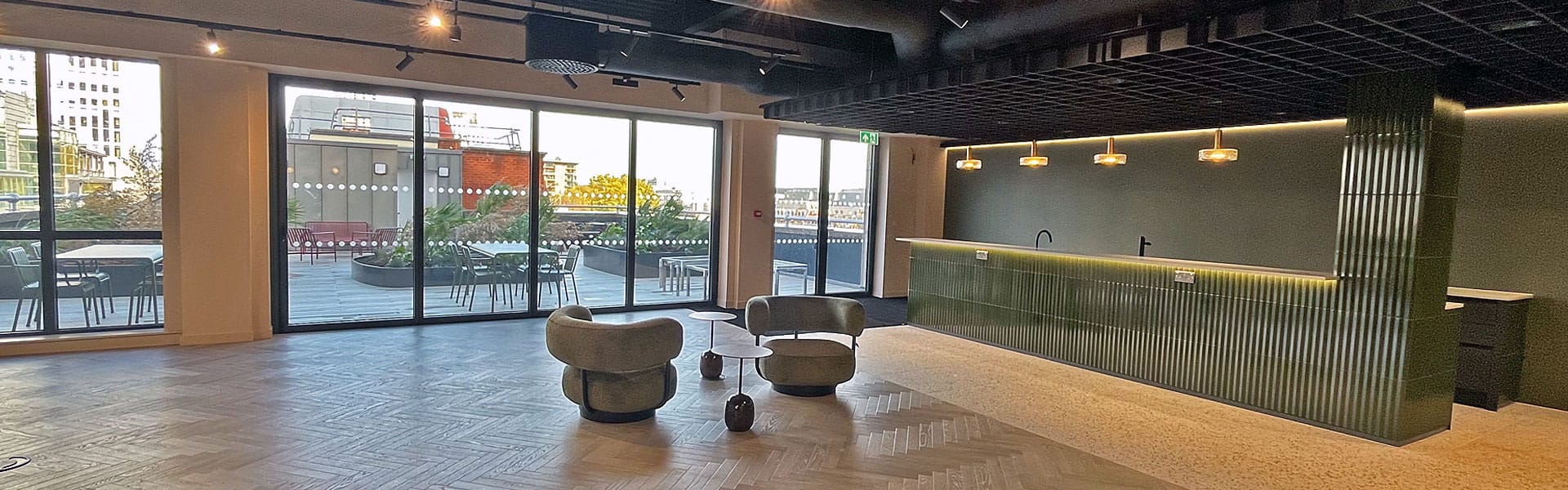
NOTE: This mandate highlights the difference between sourcing desks and creating an institutional-grade presence in the UK. Client identities are withheld, and general imagery is used to maintain confidentiality. This success story emphasises process and structure rather than attribution.